How ProHabits Pairs with Coaching, Workshops, and Leadership Programs
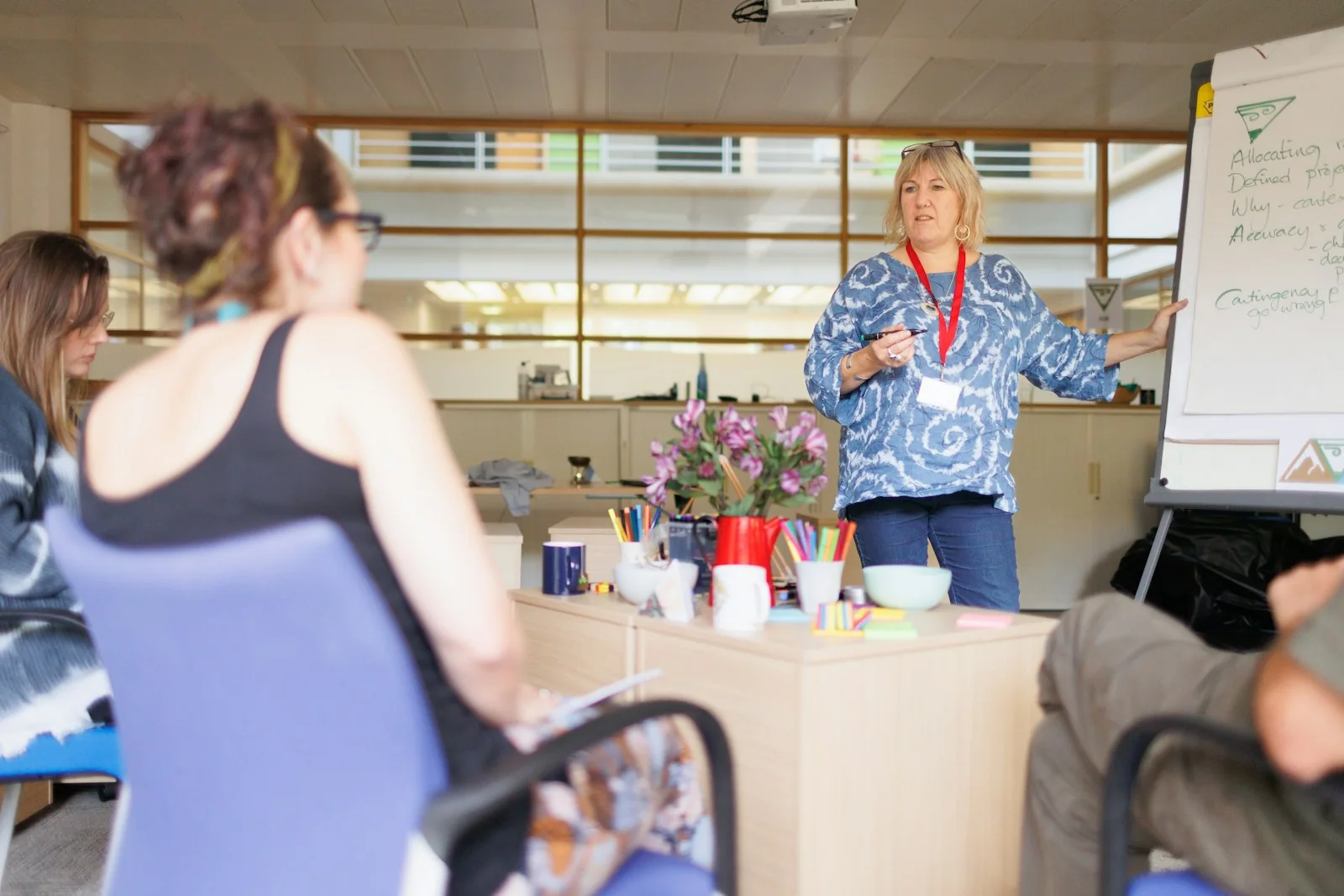
ProHabits does not replace your leadership program. It runs after it. The program creates the intent, and something has to keep that intent alive on Monday, which is the gap between a 10 to 20% classroom to job transfer rate and the 70% of development that research says happens on the job (Center for Creative Leadership). Workshops, curricula and coaching all build capability. Reinforcement converts capability into behavior, and that is a different job with a different shape.
The question L&D teams ask us is almost always the same. We already have a provider. Where does this sit?
It sits after. Not instead.
Quick answer
ProHabits is additive to leadership development, not a replacement. Workshops and curricula teach, coaching goes deep with a few people, and ProHabits keeps the behavior alive for everyone, daily, across the 66 day window that habit research says automaticity requires (Lally et al., UCL). At a global professional services firm, that pairing sustained a multi-day leadership workshop for 1,500 leaders across a three year roll out: 91% of invited participants enrolled voluntarily and 96% of commitments made were completed.
Key takeaways
- Three layers, three jobs. The program teaches, coaching deepens, reinforcement sustains. Each one's gap is another one's strength.
- The budget is inverted. 70% of development happens on the job and 10% in formal training (Center for Creative Leadership). Most budgets fund the 10.
- Coaching is deep and narrow by design. It reaches the leaders you assign it to. The middle 60% of any population is where a program succeeds or fails.
- The stacking is proven. 91% voluntary enrollment and 96% commitment completion at a global professional services firm, on top of someone else's workshop.
- We have no curriculum to sell you. ProHabits reinforces the content you already bought.
Three layers, three jobs
| Layer | Examples | What it is good at | Where it stops |
|---|---|---|---|
| The program | Workshops, curricula, offsites, providers such as CCL, FranklinCovey and DDI | Building knowledge and skill quickly, in a room, with real attention | It ends. The day after was never in scope |
| Coaching | Coaching platforms such as BetterUp, Torch and Bravely, plus internal and external coaches | Depth. Personal, adaptive, unmatched for one leader working one problem | It reaches the people it is assigned to. Deep and narrow by design |
| Reinforcement | ProHabits | Daily, everyone, in the flow of work, and measured as it goes | It does not teach the content. It needs a program worth reinforcing |
Read the last column on its own. Every gap in it is covered by a strength in another row. That is what additive actually means, and it is why the honest answer to "should we replace our provider" is almost always no.
The budget is pointed at the wrong layer
| Where development happens | Share | Where the money usually goes |
|---|---|---|
| On the job | 70% | The least funded of the three |
| From others, including the manager | 20% | Some |
| Formal training | 10% | The most funded |
The 70/20/10 model (Center for Creative Leadership) is quoted constantly and acted on rarely. Most programs put the majority of the budget into the 10 and leave the 70 to chance.
Reinforcement is not a new line item competing with the program. It is the first serious attempt to fund the 70.
Pairing with a workshop
The workshop is the easy pairing, because the behaviors are already named. A campaign is built from them and starts the day after the room empties.
| When | What runs |
|---|---|
| Before | The behaviors the workshop teaches become the campaign's daily actions |
| Day one after | Manager kickoff huddle: names the behavior, says why now, in their own words |
| Days 1 to 66 | One MicroAction a day, by email or text, ending in the I commit button |
| Every two weeks | A manager message we write, keeping the initiative audible |
| Midpoint | A manager one to one on what is working and what is stuck |
| Throughout | A recognition cascade, so early movers are visible |
| Close | The manager marks the window with the stories the campaign produced |
That is the whole ask of the manager: minutes a week, scripted. The reasoning behind putting them at the center is in The Manager Multiplier.
Pairing with coaching
Coaching is the layer people assume we compete with. We do not, and the reason is arithmetic.
Coaching is assigned. It goes to the high potentials, or to a leader working through something specific. That is the right use of it. But any leadership population sorts roughly 20/60/20: the Habiteers who move on their own, the Motivables who start and fade, and the Disengaged who do not move yet. Coaching budget concentrates on one end. The middle 60% is where the program succeeds or fails, and it is the group nobody designs for. That argument is laid out in The 20/60/20 Rule.
Run both and each one gets better. The leader gets depth from the coach and daily repetition from the campaign. The coach gets material instead of vibes: what the leader committed to, what they completed, what they reported happened when they did it.

The proof that stacking works
Every result below started with a program someone else built.
| Organization | What they already had | What the reinforcement layer produced |
|---|---|---|
| A global professional services firm | A multi-day leadership workshop for 1,500 leaders, over a three year roll out | 91% of invited participants enrolled voluntarily; 96% of commitments made were completed |
| PPG | Cohort workshops led by internal trainers | Wave one of 493 users validated before an 18 month plan for 1,500. Self reported gains: 89% positive interactions, 85% encouraged innovation |
| JetBlue | Front line supervisor development across six airports | Leadership nominations up 91% |
| Romano's Macaroni Grill | Manager development, run in half the restaurants and compared against the rest | Manager turnover cut 60% year over year; 72% of managers improved on every measured behavior |
The independent version of the same mechanism is the Claremont Graduate University field study (Felkey et al. 2021): 136 employees, prompts with a commitment across a 22 day window, a 64% check in rate against a 41% industry average, p < .001, and NPS up 15% in the first 30 days. Check in and NPS were measured directly; wider organizational outcomes were extrapolated, and saying so is what makes the measured part worth citing.
How to wire it in
Three questions decide whether a pairing will work, and they are worth asking your current provider as much as us.
What behaviors, exactly? A campaign needs named behaviors, not themes. "Better communication" cannot be a daily action. "Ask one question before offering a solution" can.
Who owns the day after? If the answer is nobody, that is the gap. If the answer is the manager, they need a script, not a request. Five short interventions across 66 days is the whole job.
What gets measured in week two? Not completion of the course. Commit rate, completion of commitments, and stories shared, by segment. Those move in weeks and predict the lagging numbers. The full method is in How to Measure Leadership Behavior Change.
90% of training vanishes in a week. ProHabits makes it stick, and it makes the program you already paid for look like the investment you hoped it was.
The full argument, with the day after framed as the product, lives here:
The Day After Leadership Training
Keep reading
- The Day After Leadership Training, the cornerstone
- The Learning Transfer Problem in Leadership Development, on the five gaps
- The Manager Multiplier, on who sustains it
- Daily Leadership Habits: What Research Says Works, on the daily unit
- The 20/60/20 Rule
- How it works
Two next steps
Bring us the program you already run and we will show you the campaign that sits behind it, or build one now around a single behavior.